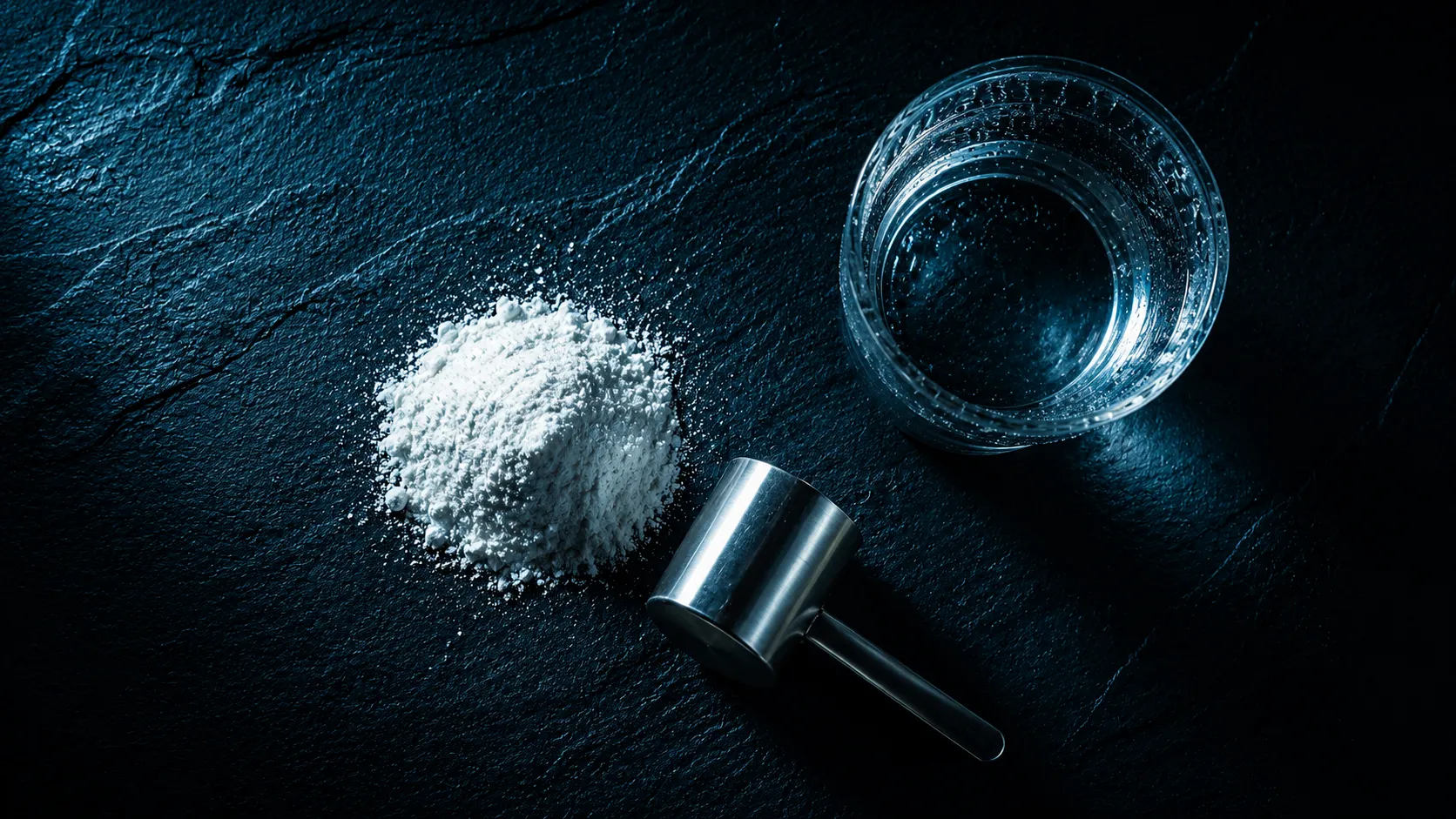
What Is Creatine and How Does It Work?
Creatine is a naturally occurring compound synthesized in your liver, kidneys, and pancreas from the amino acids arginine, glycine, and methionine. Your body stores it primarily in skeletal muscle — about 95% of total creatine sits in muscle tissue — where it plays a direct role in rapid energy production.
During high-intensity efforts like a heavy set of squats or a max deadlift, your muscles rely on the phosphocreatine system to regenerate ATP quickly. When a phosphate group is donated from phosphocreatine to ADP, ATP is rebuilt and your muscle can continue contracting. This system is fast but limited — phosphocreatine stores deplete in roughly 10 to 15 seconds of maximal effort.
Supplementing with creatine monohydrate increases the total phosphocreatine available in your muscles. More phosphocreatine means faster ATP regeneration between hard sets, which translates directly into more reps at a given load, slightly higher top-end strength, and better performance across repeated bouts of intense effort.
You already get small amounts of creatine through food — primarily red meat and fish. But dietary creatine alone typically saturates muscles to about 60 to 80% of their capacity. Supplementation pushes that to near full saturation, which is where the performance benefit comes from.
Creatine is not a stimulant, a hormone, or a shortcut. It is a fuel-system enhancer. It does not build muscle on its own — it creates conditions that allow you to train harder and recover faster, and that additional training stimulus is what drives the gains.
~95%
Approximately 95% of the body's total creatine is stored in skeletal muscle as free creatine and phosphocreatine.
ATP-PCr
Creatine supports the phosphocreatine system, which is the primary energy source for efforts lasting 10 to 15 seconds or less.
60-80%
Diet alone typically saturates muscle creatine stores to 60 to 80% of capacity; supplementation pushes stores to near full saturation.
What Does the Research Actually Say About Creatine and Strength?
Creatine monohydrate is the most studied ergogenic supplement in sports nutrition. The International Society of Sports Nutrition position stand on creatine describes it as the most effective nutritional supplement available to athletes for increasing high-intensity exercise capacity and lean body mass during training.
The meta-analytic evidence is consistent. Studies routinely report that creatine supplementation combined with resistance training produces approximately 8% greater gains in maximal strength compared to training alone, and approximately 14% greater improvements in training volume and work capacity. These are not trivial numbers — they represent a meaningful accelerant to a training program that is already well-structured.
Lean mass improvements are also well documented. A 2003 meta-analysis by Lemon and colleagues found that creatine supplementation combined with resistance training produced approximately 1.37 kg more lean mass than training without creatine over periods typically ranging from 4 to 12 weeks. More recent analyses have confirmed this finding across a wide range of populations.
The performance benefits are most pronounced in efforts lasting 30 seconds or less, repeated sprint work, and high-rep sets at submaximal loads — all highly relevant to strength and hypertrophy training. The benefit is smaller for lower-intensity aerobic efforts, which makes creatine particularly well-matched to the demands of lifting.
Importantly, these benefits accumulate over time. Creatine does not produce a dramatic overnight transformation. It creates a small but consistent performance advantage every session, and that edge compounds across months of training into genuinely meaningful strength and size differences.
~8%
Meta-analyses report approximately 8% greater gains in maximal strength with creatine plus resistance training versus training alone.
~14%
Creatine supplementation is associated with approximately 14% greater improvements in training volume and repeated-effort work capacity.
+1.37 kg
Meta-analytic data suggest creatine combined with resistance training produces approximately 1.37 kg more lean mass than training alone over 4 to 12 weeks.
Which Form of Creatine Should You Take?
Creatine monohydrate. That is the answer for virtually every lifter. Monohydrate is the form used in the overwhelming majority of research, it is the most cost-effective option available, and it has a decades-long safety and efficacy record that no other form can match.
The supplement market offers a long list of alternatives — creatine HCL, buffered creatine (Kre-Alkalyn), creatine ethyl ester, creatine nitrate, and others. These forms are typically marketed with claims about better absorption, fewer GI issues, or superior effectiveness. The independent research does not support those claims.
A 2012 study comparing creatine monohydrate directly to creatine ethyl ester found that monohydrate produced greater increases in muscle creatine levels and superior strength and body composition outcomes. Creatine HCL is better soluble in water, which can reduce the chalky texture some people notice, but absorption and muscle saturation outcomes are not meaningfully different from monohydrate at the doses used in practice.
The GI issues sometimes attributed to monohydrate — bloating, cramping, loose stools — are typically caused by taking large doses in one sitting or taking creatine with insufficient water. Splitting the dose across the day or simply using 3 to 5 grams at once with a full glass of water resolves this for most people.
Micronized creatine monohydrate is worth considering if texture or mixability bothers you. It is the same compound processed into smaller particles that dissolve more easily in water. The performance and safety profile is identical to standard monohydrate — it is just easier to mix.
Monohydrate
Creatine monohydrate is the most researched, most cost-effective, and best-validated form — supported by hundreds of independent studies.
No advantage
HCL, buffered, and ethyl ester forms are not shown to outperform monohydrate for muscle saturation or performance in independent research.
Dose-related
GI discomfort is typically caused by large single doses or insufficient water — not inherent to creatine monohydrate itself.
Do You Need to Load Creatine?
No, loading is not required. It is faster, but it is not necessary. You will reach full muscle saturation either way — loading just gets you there in about a week instead of three to four weeks.
The loading protocol is 20 grams per day split into four 5-gram doses for 5 to 7 days, followed by a maintenance dose of 3 to 5 grams per day. This approach rapidly saturates muscle creatine stores and delivers the performance benefits within days. It is useful if you are starting creatine close to a competition, a testing week, or a high-priority training block.
The gradual approach skips the loading phase entirely and uses 3 to 5 grams per day from day one. Muscle stores saturate fully over approximately 28 days. The end state is identical to loading — your muscles are just as saturated — but the ride there is slower and gentler on the digestive system.
For most lifters, the gradual approach is the better starting point. The performance difference between being fully loaded in week one versus week four is small when measured against a multi-year training career. The loading phase can also cause transient GI discomfort in some people, which creates unnecessary friction when you are trying to build a new habit.
Once you have been on maintenance for several weeks, do not cycle off creatine unless you have a specific reason to. The old idea that creatine cycling preserves sensitivity has not held up in the research. Consistent daily use maintains saturation and keeps the performance benefit active.
5-7 days
A loading protocol of 20 g/day for 5 to 7 days saturates muscle creatine stores rapidly.
~28 days
A maintenance-only approach of 3 to 5 g/day reaches full muscle saturation in approximately 28 days.
Identical
Both approaches produce the same fully saturated end state — loading is faster, not better.
Does Timing Matter — Before or After Your Workout?
Timing matters far less than consistency. The performance benefit of creatine comes from having chronically elevated phosphocreatine stores in your muscles, not from a pre-workout spike. Creatine is not a stimulant — there is no acute effect from taking it immediately before training.
That said, a small but consistent body of research suggests that taking creatine close to your workout — particularly post-workout — may produce marginally greater lean mass and strength improvements than taking it at a more distant time, such as first thing in the morning. A 2013 study by Antonio and Ciccone found a small advantage for post-workout creatine timing, though the difference was not dramatic.
The most practical interpretation is this: take creatine at a time that makes it easy to remember and consistent to repeat. For many lifters, that means mixing it into a post-workout shake or taking it with a meal. If you train in the morning and prefer to take it at night, that is fine too. Missing days because the timing feels inconvenient is far more costly than optimizing the window.
Taking creatine with carbohydrates or protein has been shown to enhance uptake slightly, likely due to the insulin response improving creatine transport into muscle. A meal or a shake that includes both carbs and protein is a natural pairing. You do not need a large dose — a normal mixed meal is sufficient.
Rest days count too. Many lifters only take creatine on training days, but maintenance dosing on rest days is equally important for keeping stores saturated. Think of it as a daily supplement, not a pre-workout.
Consistency
Daily consistency matters far more than the specific window — missing days reduces muscle saturation regardless of timing precision.
Post-workout
Small research signal suggests post-workout creatine may slightly outperform distant timing for lean mass and strength gains.
Carbs + protein
Taking creatine with a mixed meal or shake containing carbohydrates and protein can enhance muscle uptake via the insulin response.
Will Creatine Make You Gain Weight or Look Bloated?
Yes, creatine causes weight gain — but not the kind most lifters are worried about. The initial weight increase is intramuscular water retention. Creatine draws water into muscle cells as part of its storage mechanism, which is why muscle fullness often improves noticeably in the first few weeks. This water is inside the muscle, not under the skin.
The typical initial weight gain from creatine loading is 1 to 2 kilograms in the first one to two weeks, most of it water stored in muscle tissue. This is not fat gain, it is not subcutaneous bloating, and it does not make you look soft. Many lifters notice the opposite — muscles appear fuller and harder as intramuscular water increases.
Over the following weeks and months, additional lean mass accumulates from the improved training stimulus creatine enables. This longer-term lean mass gain is actual muscle tissue, not water. The two effects are distinct: the first happens quickly and is mostly water; the second builds gradually and is structural.
If you are cutting or in a weight-class sport, the initial scale jump is worth accounting for in your planning. Creatine during a cut is still generally beneficial for preserving strength and lean mass, but the 1 to 2 kg water increase will temporarily affect your weigh-in number.
If you stop taking creatine, your muscle creatine stores decline over two to four weeks and the intramuscular water comes with them. The scale will drop by roughly the amount it rose when you started. Actual muscle tissue built during supplementation is retained — only the water component leaves.
1-2 kg
Most lifters gain 1 to 2 kilograms of intramuscular water in the first one to two weeks of creatine use — not fat.
Intramuscular
Creatine draws water into muscle cells, not under the skin — muscle fullness improves, not subcutaneous bloat.
2-4 weeks
Muscle creatine stores and associated water return to baseline within 2 to 4 weeks of stopping supplementation.
Is Creatine Safe? What About the Kidney Concern?
Creatine monohydrate has one of the strongest safety records of any supplement ever studied. The ISSN position stand states that short- and long-term use of creatine in healthy populations — including adolescents, adults, and older people — is safe and well-tolerated, with no documented adverse effects on kidney, liver, or cardiovascular function at recommended doses.
The kidney concern persists in popular culture but is not supported by the evidence in healthy individuals. It originates partly from the fact that creatine supplementation increases serum creatinine levels — a common kidney function marker. However, this increase is an expected consequence of higher creatine turnover and is not an indicator of kidney damage or impaired function in people without pre-existing kidney disease.
Multiple long-term studies have examined creatine supplementation over periods of months to years and found no harmful changes in kidney function markers beyond the expected creatinine elevation. A 2019 review of the long-term safety literature concluded that creatine supplementation at doses of 3 to 5 grams per day poses no risk to healthy adults.
The one population that should consult a doctor before using creatine is people with pre-existing kidney disease, a single kidney, or conditions that directly affect kidney function. For this group, the baseline assumption of safety does not automatically apply. Everyone else — healthy adults without a documented kidney condition — has no evidence-based reason to avoid creatine.
Creatine has also been studied in contexts beyond sport, including neurological conditions, heart failure, and aging-related muscle loss. The safety signal across these diverse use cases is consistent. Over 500 peer-reviewed studies have examined creatine supplementation, making it one of the most thoroughly investigated compounds in sports science.
500+
Over 500 peer-reviewed studies have examined creatine supplementation, making it one of the most researched compounds in sports nutrition.
None in healthy adults
Long-term research finds no evidence of kidney damage in healthy individuals — the creatinine elevation seen on bloodwork is expected and benign.
Pre-existing kidney disease
People with pre-existing kidney conditions should consult a doctor before using creatine — the general safety data does not automatically apply.
Does Creatine Work Differently for Lifters Over 35?
Yes — and arguably better. The research on creatine and aging muscle is one of the strongest arguments for supplementation that most lifters over 35 have never heard. After age 30, adults lose approximately 3 to 5% of muscle mass per decade through a process called sarcopenia. That rate accelerates after 60. Creatine directly targets several of the biological mechanisms driving this loss.
A 2003 meta-analysis by Brose et al. found that creatine supplementation combined with resistance training in older adults produced significantly greater gains in lean mass, strength, and functional performance than training alone — with effect sizes comparable to or exceeding those seen in younger populations. The authors concluded that creatine may be a particularly effective intervention for attenuating age-related muscle loss.
Part of the reason creatine works especially well for older lifters is that dietary creatine intake tends to decline with age. Red meat consumption — the primary food source — drops in many people's diets as they get older, meaning older adults often start with lower baseline muscle creatine stores and have more room to improve from supplementation.
There is also emerging research on creatine's effects beyond muscle — specifically on bone density, cognitive function, and injury resilience, all of which become increasingly relevant after 35. While the strength and body composition data are the most robust, the broader profile makes creatine one of the few supplements with a genuinely compelling case for lifters playing a longer game.
The protocol does not change. Three to 5 grams of creatine monohydrate per day is as effective for a 45-year-old as for a 25-year-old. The difference is that the older lifter arguably has more to gain — and the research backs that up.
3-5% / decade
Adults lose approximately 3 to 5% of muscle mass per decade starting in their 30s — a process creatine combined with training directly counters.
Strong
Meta-analyses consistently show creatine plus resistance training produces significant lean mass and strength gains in adults over 55, comparable to younger populations.
Lower stores
Older adults often have lower baseline muscle creatine from reduced red meat intake, giving supplementation more room to produce a measurable effect.
How Do You Know If Creatine Is Actually Working?
Most lifters take creatine for a few weeks, notice the scale went up by a kilogram, and assume it is working. That tells you your muscles are holding more water — a sign of saturation — but it does not tell you whether creatine is actually improving your training output.
The real test is your performance log. Creatine's primary mechanism is allowing you to do more work at a given load — more reps, better output on later sets, less fatigue across a session. If creatine is working, those numbers should trend upward over a 6 to 8 week window of consistent supplementation alongside consistent training and nutrition.
Specifically, look at your estimated 1RM on your main lifts. Creatine does not produce overnight strength gains. It produces a small, consistent edge every session — more reps at a given weight, slightly more load possible at a given rep range. Over 6 to 8 weeks of logged data, that edge becomes visible as a positive slope on your e1RM trend. If the slope is flat or negative with everything else held constant, investigate training load, sleep, and protein before blaming the supplement.
Also watch for reduced intra-session rep drop-off. One of creatine's clearest effects is that your second and third working sets hold closer to your first set performance. If you were previously losing 3 reps between set one and set three and that gap narrows, creatine is doing its job.
What creatine cannot compensate for: insufficient training stimulus, inadequate protein, poor sleep, or too much volume relative to recovery capacity. If any of those variables are off, creatine's edge will be invisible in the data. Fix the big inputs first, then use creatine to squeeze more out of an already sound program.
6-8 weeks
Allow 6 to 8 weeks of consistent use with stable training and nutrition before drawing conclusions from your performance data.
e1RM trend
An upward slope in estimated 1RM on main lifts over the review window is the clearest data signal that creatine is producing a performance return.
Set drop-off
Reduced rep drop-off between your first and later working sets is one of creatine's most consistent and measurable effects.
Creatine FAQ: Common Questions, Direct Answers
Can women take creatine? Yes — the research in women is strong and consistent. Women typically have lower baseline muscle creatine stores than men, which may make the response to supplementation more pronounced. The dose, form, and protocol are identical.
Does creatine cause hair loss? This concern originates from a single 2009 study in rugby players that found creatine increased DHT levels — a hormone associated with male pattern baldness. That study has not been replicated, and no controlled trial has directly shown creatine causes or accelerates hair loss. It remains a theoretical concern based on limited evidence.
Can you take creatine while cutting? Yes — and there is a specific reason to. During a calorie deficit, the risk of losing lean mass alongside fat increases. Creatine helps maintain strength output and training performance under reduced energy availability, which preserves the training stimulus needed to retain muscle. The initial water retention may temporarily affect a weigh-in number, but the trade-off for lean mass preservation is generally worth it.
Do you need to take creatine every day? Yes — daily maintenance is what keeps muscle creatine stores saturated. Missing occasional days will not undo your saturation, but chronic inconsistency will slowly reduce stores. Take it at the same time each day, including rest days.
What if creatine upsets your stomach? Large doses taken dry or without water are the most common cause. Take 3 to 5 grams with a full glass of water alongside a meal. If discomfort persists, switch to micronized creatine monohydrate — same compound, smaller particles that dissolve more easily and cause fewer GI symptoms for most people.
Same protocol
Women use the same dose, form, and protocol — and may have lower baseline stores that make the performance response more noticeable.
Not replicated
The single study linking creatine to DHT elevation has not been replicated — no controlled trial has shown creatine causes hair loss in humans.
Beneficial
Creatine during a calorie deficit helps preserve strength output and the training stimulus that protects lean mass alongside fat loss.
What Is the Bottom Line on Creatine for Strength Athletes?
Creatine monohydrate is the most evidence-backed supplement available to strength athletes. It increases phosphocreatine availability in muscle, which supports faster ATP regeneration, more reps at a given load, and better performance across repeated hard sets. Over months of consistent use, those small session-by-session advantages compound into meaningful gains in strength and lean mass.
The protocol is simple: 3 to 5 grams of creatine monohydrate per day, taken consistently, with or without food, at any time that is easy to remember. No loading phase is required unless you want faster initial saturation. No cycling is needed. No expensive form is necessary — standard monohydrate from a third-party tested brand is all you need.
The weight gain in the first week or two is intramuscular water, not fat. The kidney concern is not supported by the evidence in healthy adults. The timing window matters far less than daily consistency. These are the most common sources of confusion, and none of them are reasons to avoid creatine.
The best way to confirm creatine is working for you is to track your performance. If your e1RM on your main lifts trends upward over 6 to 8 weeks while your training and nutrition are consistent, your supplementation is doing its job. If performance is flat, investigate training load, sleep, and nutrition before blaming the creatine.
This article is educational and reflects the current research consensus. If you have a pre-existing kidney condition, single kidney, or a medical condition affecting kidney function, speak with your doctor before using creatine. This guidance does not substitute for medical advice tailored to your specific health history.
3-5 g
3 to 5 grams of creatine monohydrate per day is the evidence-supported maintenance dose for most adults.
Monohydrate
Standard creatine monohydrate from a third-party tested brand is all you need — no premium form outperforms it.
e1RM trend
Track your estimated 1RM on main lifts over 6 to 8 weeks of consistent use to confirm creatine is producing a performance return.